Midjourney: The 11-Person Startup Making $200M Without VC Money
In 2023, while OpenAI was frantically raising $10 Billion from Microsoft and burning through cash just to keep its servers alive, another AI company quietly crossed $200 million in revenue.
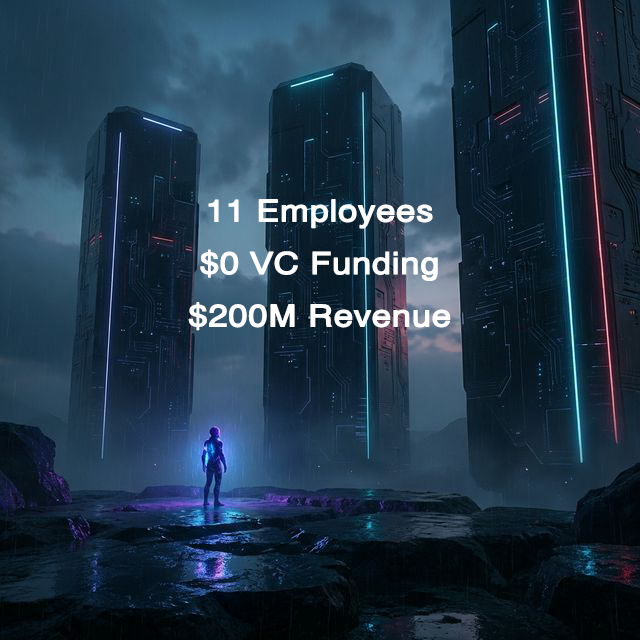
The kicker? They didn't take a single dime of venture capital. They had zero PR team. They didn't even have their own web interface. And their core team consisted of just 11 people.
This is the story of Midjourney—the ultimate "David vs. Goliath" of the AI era. In a market dominated by trillion-dollar tech titans like Google, Meta, and Microsoft, how did a bootstrapped, tiny team build the world's most popular AI image generator?
Let's dissect the genius, and slightly rebellious, playbook of David Holz.
The Anti-Silicon Valley Founder
To understand Midjourney, you have to understand its founder, David Holz.
Before diving into generative AI, Holz founded Leap Motion, a company that built hand-tracking hardware for VR and AR. Leap Motion was a classic Silicon Valley darling. It raised over $100 million from top-tier venture capitalists, scaled aggressively, and played the hype game.
But Holz hated the experience.
He learned a painful lesson: VC money isn't free. It comes with board seats, relentless pressure for hyper-growth, and a loss of creative control. When you take VC money, your primary customer is no longer the user—it's the investor.
When Holz left Leap Motion to start Midjourney, he made a vow. He would never take venture capital again. He didn't want to build an "enterprise SaaS unicorn"; he wanted to build an independent research lab.
By refusing outside money, Holz protected his small team from the "growth-at-all-costs" virus. They didn't need to appease a board of directors; they only needed to build something people loved enough to pay for.
The Discord Masterstroke (Friction as a Feature)
If you want to build a software company today, the conventional wisdom says you need a slick website, an iOS app, and a buttery-smooth user onboarding experience. That means hiring expensive frontend developers, mobile engineers, and UX designers.
Midjourney ignored all of that. They didn't build an app. They built a bot inside Discord.
At first, tech critics laughed. Discord is a chat app for gamers. Forcing users to type <code>/imagine</code> into a chaotic chat room to generate an image seemed clunky and unprofessional. But this "flaw" was actually Midjourney’s greatest growth hack.
Here is why the Discord strategy was a masterstroke:
- Zero Infrastructure Costs: Midjourney didn't have to build social features, user accounts, or messaging architecture. Discord handled it all for free.
- The Viral Flywheel: Because users generated images in public chat rooms, every prompt was visible. When a user created a breathtaking piece of art, hundreds of other users saw it instantly. It created a massive flywheel of inspiration and FOMO (Fear Of Missing Out). Users learned how to write better prompts just by watching each other in real-time.
- Friction as a Filter: Yes, Discord was confusing for the average person. But this friction filtered out low-intent users. Those who took the 5 minutes to figure it out were highly engaged, highly motivated, and much more likely to pull out their credit cards.
The Business Model: Simplicity is the Ultimate Sophistication
Silicon Valley loves "freemium" models subsidized by billions in VC cash. The strategy is usually: acquire users for free, bleed money for 5 years, and figure out how to monetize later.
Because Midjourney was entirely self-funded, they didn't have the luxury of bleeding money. They had to be profitable from Day 1.
Their solution was an incredibly simple, recurring subscription model. No enterprise sales teams. No convoluted token systems. Just straight-up, monthly web subscriptions ranging from $10 to $120.
When you do the math, the brilliance of their lean structure becomes obvious:
With a reported 15+ million users in their Discord server, even if a highly conservative 10% (1.5 million) convert to the basic $10/month plan, that generates $15 million in monthly recurring revenue (MRR).
Now, subtract the salaries of an 11-person team. Even with massive computing (GPU) costs to generate the images, the profit margins are staggering. They achieved what Uber, WeWork, and Spotify spent decades (and billions) trying to do: massive scale with actual profitability.
Surviving the Giants: The Aesthetic Moat
But how do 11 people survive when Google (Imagen), Microsoft (DALL-E 3), and giant open-source communities (Stable Diffusion) enter the chat?
When Goliath attacks, David doesn't fight him in close combat. David uses a slingshot.
Midjourney’s slingshot is its Aesthetic Opinion.
If you ask DALL-E 3 for an image, it interprets your prompt literally and accurately. It’s a scientific tool.
If you ask Midjourney for an image, it makes it beautiful, dramatic, and cinematic. It acts as an art tool.
David Holz explicitly tuned Midjourney to have a default "vibe." This aesthetic bias became their impenetrable moat. For creative professionals, game designers, and digital artists, Midjourney isn't just an image generator; it’s a co-creator with good taste.
Furthermore, an 11-person team can pivot and ship updates in days. A 10,000-person corporation like Google requires months of bureaucracy, legal reviews, and safety committee approvals before releasing a minor update. Speed is the ultimate weapon of the small.
The Playbook for the Next Generation
Midjourney's story shatters the modern startup myth. It proves that you don't need a massive team, endless venture capital, or even a standalone app to build a world-class technology business.
Here are the core takeaways for your own entrepreneurial journey:
- Bootstrap if you can: Protecting your equity means protecting your vision.
- Leverage existing platforms: Don't build what you can borrow (like Discord).
- Community-led growth beats paid ads: Let your product's output be its own marketing.
The next billion-dollar business might not come from a shiny glass office in Silicon Valley. It might just come from a small group of friends running a Discord server.
Over to You
Do you think a bootstrap model like Midjourney's can work in other industries, or is AI a special exception? Let us know your thoughts in the comments below!